

A couple of weeks ago, just before we broke up for Half Term, something felt a little off. One of our fairly new Scouts, let’s call him Ben (not his real name, of course), arrived just in the nick of time for our meeting. This was unusual; he’s normally one of the first through the door, always on time.
This time, he also arrived in his Scout uniform but without his necker – again, very unlike him. More than that, he just looked… sad. Withdrawn. There was a definite cloud over him.

His dad, who dropped him off, caught my eye and quietly handed me Ben’s necker. ‘Look after him, Mark,’ he said with a worried glance. ‘He’s not his normal self, and I honestly don’t know why. He even refused to come to Scouts this evening, which really isn’t like him at all.’
My Leader senses were tingling. That evening, our programme was a ‘hike’ to the nearby park – a pleasant 10-minute walk, as it was a beautiful summer evening, perfect for some wide games.
But Ben? He was right at the back of the Troop as we walked, head down, kicking every loose stone and stray Coke can he could find, almost as if he was deliberately trying to drag the walk out. It was clear something wasn’t right.
When we got to the park, while the others dived enthusiastically into the wide games, Ben flat-out refused to join in. This was my moment to try and understand what was going on.
My approach to him was gentle. ‘Everything okay at home?’ I asked. ‘Any problems at school? You know you can talk to me – Scouts is a safe space, Ben.’

And then it came out. He apologized, saying, ‘No offence, Mark, but Scouts just isn’t what I thought it would be.’ When I asked him to explain, he said he’d much rather just play games such as Dodgeball all evening instead of doing badge work. He confessed he had no interest in camping anymore, or learning DIY skills, First Aid, and even questioned how relevant something like Tracking could possibly be for him.
I explained, as gently as I could, that while games are a big part of the fun at Scouts, Scouting is also about learning new skills – those ‘skills for life’ we hear so much about. His response? He just blanked me, staring off into the distance of the park, and asked to be left alone to think.
And that left me with a lot to think about.
My first feeling was genuine confusion. This was a lad who, up until this point, had always seemed to enjoy our meetings, always engaged when we were at the Scout hall. Where had this sudden shift come from? His dad’s earlier comments about him ‘not being his normal self’ echoed in my mind, and seeing this usually positive, smiling Scout so withdrawn definitely sparked a concern for his general well-being beyond just our Scout night.
Then there’s the programme aspect. Could we really play games all evening, every week? I knew instinctively that wasn’t sustainable or true to the broader aims of Scouting. We often use game-heavy nights at the start of term, especially when new members join, to build camaraderie and ease everyone in, but the core of Scouting is more than that. His disinterest in camping and core skills – the very things I see so much value in – was a tough pill to swallow. It wasn’t so much frustration, perhaps, but more a quiet sense of… disappointment? Or maybe a Leader’s natural desire to see every young person ‘get’ the bigger picture we work so hard to paint.

The toughest part? Knowing I wouldn’t be there the following week due to work commitments. And with Half Term looming straight after, it meant a significant gap before I’d even know if Ben would return. While life outside Scouts rightly takes precedence – family and work are, of course, my priorities – the unresolved nature of this situation would undoubtedly sit at the back of my mind.
So, Scout Leaders, What Would YOU Do?
And that brings me to why I’m sharing this story with you, my fellow Scout Leaders. This isn’t an uncommon scenario, is it? We’ve all likely faced moments where a young person’s enthusiasm dwindles, or their expectations of Scouting don’t quite match the reality of our programme.
So, I throw it open to the collective wisdom of the ‘Big Man in the Woods’ community:
- What would you have done in my shoes that evening with Ben? Would your approach have been similar, or different?
- I instinctively felt I had to ask if he was okay, especially given his dad’s concerns and his withdrawn behaviour. Do you agree that stepping in pastorally was the right first move?
- How do you generally handle it when a young person explicitly says they’re not enjoying core Scouting activities like camping, badge work, or skills sessions, and would rather just play games?
- What are your best strategies for balancing the ‘fun and games’ aspect with the ‘skills for life’ and badge work requirements to keep a diverse group of Scouts engaged and motivated?
- And perhaps most importantly, do you have any tried-and-tested tips for re-engaging a Scout who seems to be drifting away or losing their spark for the programme?
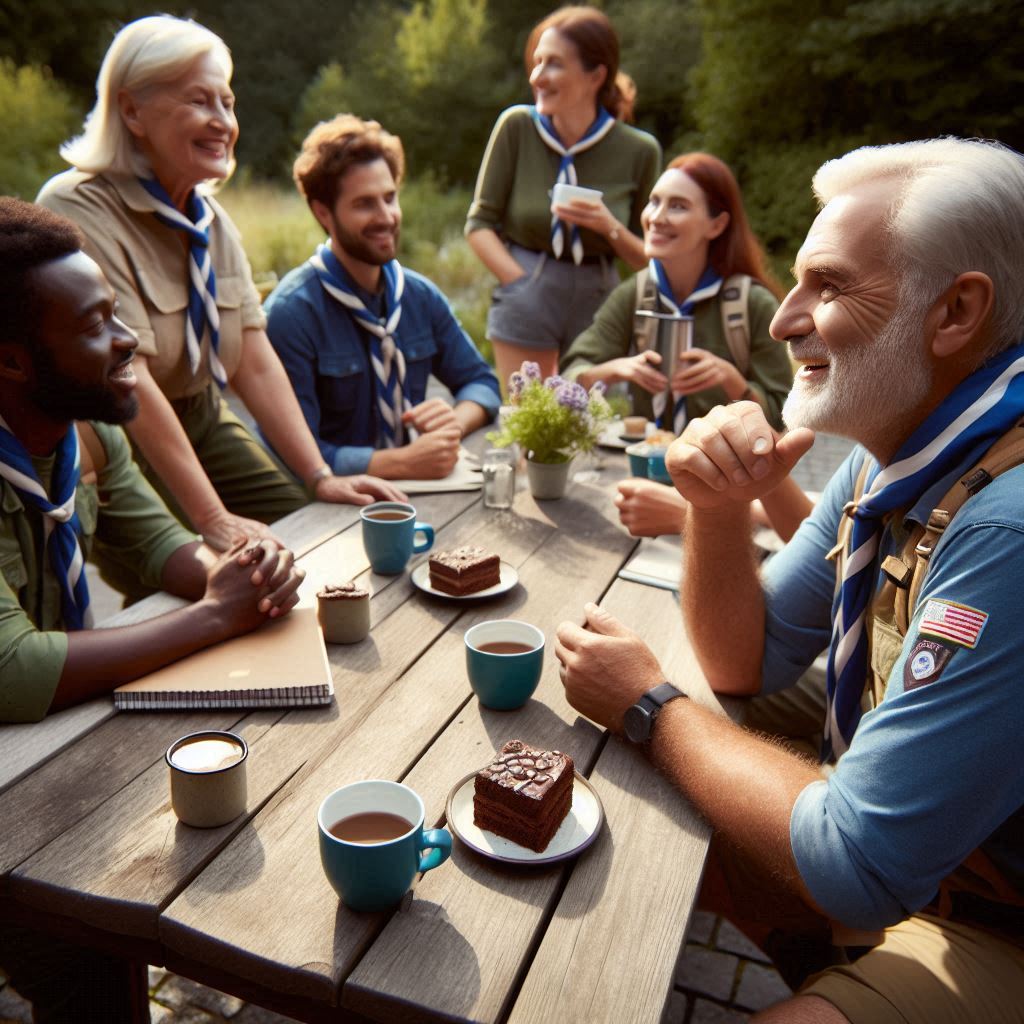
I’m genuinely keen to hear your perspectives. Every Leader brings a different set of experiences, and there’s always something new to learn.
My Own Thoughts on Next Steps
While I’m waiting to see if Ben returns after the break, and eagerly anticipating your advice, a few initial thoughts on potential next steps have been running through my mind:
- An Informal Follow-Up: If Ben does come back, my first priority will be a quiet, informal chat to simply see how he’s feeling. Has anything changed? Has he had more time to process his thoughts?
- Connecting with Dad (Carefully): Depending on that conversation, and ensuring Ben is comfortable with it, a brief, supportive chat with his dad might offer more insight into whether there are external factors influencing his feelings.
- Programme Presentation: Ben’s feedback is a valuable reminder to constantly think about how we present core Scouting skills. Perhaps there are ways to frame activities like tracking or DIY to make them feel more immediately relevant or exciting for his age group – maybe by linking them to a challenge he would find engaging.
- Finding His Niche: Could there be a specific role or responsibility within the Troop that Ben might enjoy, even temporarily? Sometimes, giving a young person a specific purpose that plays to their strengths can reignite their interest.
- Accepting All Outcomes: And, as hard as it can be, I also need to be prepared for the possibility that, despite our best efforts, Scouting might not be the right fit for Ben right now. If that’s the case, supporting him in that decision without judgment is also part of our pastoral role.

The Ongoing Journey
Situations like this are part and parcel of the rewarding, yet often complex, journey of being a Scout Leader. They remind us of the importance of listening, being adaptable, and leaning on the collective wisdom of our Scouting community. I look forward to reading your thoughts and advice in the comments below – let’s help each other navigate these challenges together!




18 Comments
It’s really important to get their input because maybe it’s something we are doing or a simple thing that we can change. But then some young people have that scouting spirit in them, some stay for the giggles and mates, and others for the fun stuff they do. So that’s the thing really, what keeps people in the movement? I think of people like Ben Pardon who is an amazing scooter and just has that scouting magic, or some of the explorers in West London who are now leaders
It’s really important to get their input because maybe it’s something we are doing or a simple thing that we can change. But then some young people have that scouting spirit in them, some stay for the giggles and mates, and others for the fun stuff they do. So that’s the thing really, what keeps people in the movement? I think of people like Ben Pardon who is an amazing scooter and just has that scouting magic, or some of the explorers in West London who are now leaders
What a fantastic perspective, Leigh thank you! I love your point about the ‘Scouting magic’ and the different motivations. It really gives food for thought. Cheers for sharing!
This reads so much like the ‘Alfie’, ‘Billy’ and ‘Charlie’ (A,B, and C) situation I faced in about 1982, in my first job as Scout Leader. A, B and C were the only three Scouts in the troop when I took over. Of the three, B & C were inseparable best friends. B was a particularly enthusiastic Scout with a highly engaging personality.
B & C had known each other from Primary School but had gone in different secondary directions. B lived on my route home, so I’d often walk along the high street with him, listening to him chatting animatedly about all manner of things. And back before ‘safe spaces’ were fashionable, all the Scouts knew they had a listening ear in the troop if ever they needed it.
With doing more interesting activities, our numbers grew. Then one evening C told me B had left. C was particularly upset because B had given him no reason for leaving. Like C, I was devastated by this news. During a very long subsequent telephone conversation with him, B could give no specific reason for wanting to leave. He was enjoying the activities, friends, etc, but was adamant about leaving.
What B also did, still gnaws at C today. He instantly cut off all communications with C and others in the Scout Troop. He then left the area. And despite decades of attempts to find him and the advice from his wife to drop it, B’s whereabouts remain a mystery. BTW, C met his future wife D when they were 16. And against all advice they married at 18 – I was their best man – to choruses of ‘it will never last’. Well, it’s still going.
So, while today I remain good friends with A and C, and most of my Scouts from my first troop, I still wonder what happened to B.
However, I would now look at such a situation through the eyes of the child. And for all this talk about ‘young people’ they are CHILDREN when all is said and done. They are exploring the world and trying to find their place in it. As such, their enthusiasm for things waxes and wanes at a far greater speed than ours does – and rightly so.
As a Beaver leader, I found this all the time. The bright-eyed turquoise ninja who was so keen to be invested six weeks ago, has now discovered ballet, and has pirouetted off into the night. “They love something one minute and then, before you know it, they’ve gone off it again” was what Beaver parents used to say. And in front of the Beaver and those parents, I would comment that having an open mind and a willingness to try lots of things was a sign of great intelligence. And if a Beaver did leave, they would get the card thanking them for their contribution to Beavers, telling them the door was always open if they wished to return and enthusiastically wishing them the best for the future.
And that is also how I would now deal with a Scout. I have often spoken about the cult-like nature of being a Scout LEADER. I realised this when I stopped and found people of my age had done so many things that my blinkered commitment to Scouting had never occurred to me to do, like for example, taking acting lessons at a top drama school and volunteering as a theatre usher.
We forget, when we are doing Scouting seven nights a week, and missing out on family events while spending all our spare cash on outdoor kit, and deciding what house and car to buy, and organising our careers, purely in order to ensure that Scouting remains top of the list of our life’s priorities, what it is like for a child.
It is just a couple of hours a week to them and part of a much larger network in their lives of home, school, church and other activities such as sports. And while it is right and proper that we care for them, when we are lucky enough to have them, it is not a healthy thing to care too much. While they are with us, enjoy their company and make things as enjoyable and as memorable as possible for them. You will get rewarded for doing that. I did, when recently two Scouts from 40 years ago, who now live thousands of miles apart, rang me up to say they were meeting up for a reunion.
But if they want to go, let them go and say thank you very much, and goodbye.
You’re absolutely right Shaun – enjoy them while they’re with us, make it memorable, and if they choose to go, wish them well with an open door. That call from your Scouts 40 years on is a testament to the impact you clearly made. Thank you for such a profound and beautifully written contribution to this discussion.
So, i have been in a position similar to this scenario. I had a chat with patent and scout at a local Cafe. There we discussed what the scout would like to see in the program and then gave them the opportunity/option to lead the night. They haven’t missed another night yet.
Wow, Carolyn, that’s such a great success story – thanks for sharing! I love the proactive approach of a three-way chat and then directly empowering the Scout to shape and lead part of the programme.
It really shows how giving young people that ownership can make all the difference. The fact they haven’t missed a night since speaks volumes! Really appreciate you adding this valuable experience to the discussion.
The article was an interesting read. Yes, I’ve been there. Some wins and losses.
Mark please update us after your break. Did ‘Ben’ return and were changes made? ⚜️
Thanks so much for reading and for your comment, Randy! It’s good to hear from others who’ve ‘been there’ – those wins and losses are definitely part of the journey, aren’t they?
And yes, absolutely! I’ll be sure to post an update on the blog about ‘Ben’ and any developments once we’re back from the break and I have a chance to see how things unfold. Thanks for asking!
If we give scouts the chance to lead and take responsibility then that is something they may not get elsewhere.
I’m afraid my experience is that by the time a scout asks that question they’ve already been grabbed by another interest and all I can say is that I hope they take something of scouts with them through life.
I don’t consider it a dilemma.
Thanks for sharing your experienced perspective, Peter. You’re absolutely right that giving Scouts the chance to lead and take responsibility offers unique growth they might not find elsewhere – that’s a core strength of the movement.
Your point about them often having another interest by the time the question is asked is a very real observation too, and it’s a good hope that they carry Scouting values forward. I appreciate your view that it’s less of a ‘dilemma’ from your standpoint – definitely gives a different angle to consider. Cheers!
I’ve found that having asked the welfare type questions that it can be anything up to a month before the real reasons come out.
Sometimes, and it’s hard when it happens, they just don’t want to scout any longer.
Thanks so much for sharing your experience, Helen. That’s such an important point about patience – you’re absolutely right, the real reasons can often take time to surface. And yes, it’s always tough when a young person decides Scouting isn’t for them anymore, but as you say, sometimes that’s just the reality. Really appreciate your perspective!
I scout in Australia and we are very much more focused on Youth Led, Adult supporting. The youth decide on the program and then provide us with a Lead and Assist for each week. Ours need to achieve a certain amounts of leads and assists for each of their ‘Milestone badges’. This system ( we had a big badge/Award system overhaul some years ago) has taken some time for us to implement successfully but it is bearing fruit now and I feel the youth feel more’ invested on what they are doing, which is probably the way Baden Powell intended it to be in the first place.
Thanks for sharing, Debbie! That youth-led approach in Australia sounds fantastic. It’s great to hear how it’s empowering your youth and making them feel so invested – definitely what Baden-Powell envisioned!
I don’t think it’s a disaster when young people move on to other interests. Not everyone can be into scouting forever. They will still have got something from it.
That’s such an important perspective, Ruth. Even if they move on, the skills and memories from Scouting often last a lifetime.
This really highlights how important it is for leaders to notice the little signs. Not every kid will come out and say something’s wrong, but your sensitivity gave Ben the space to be honest.